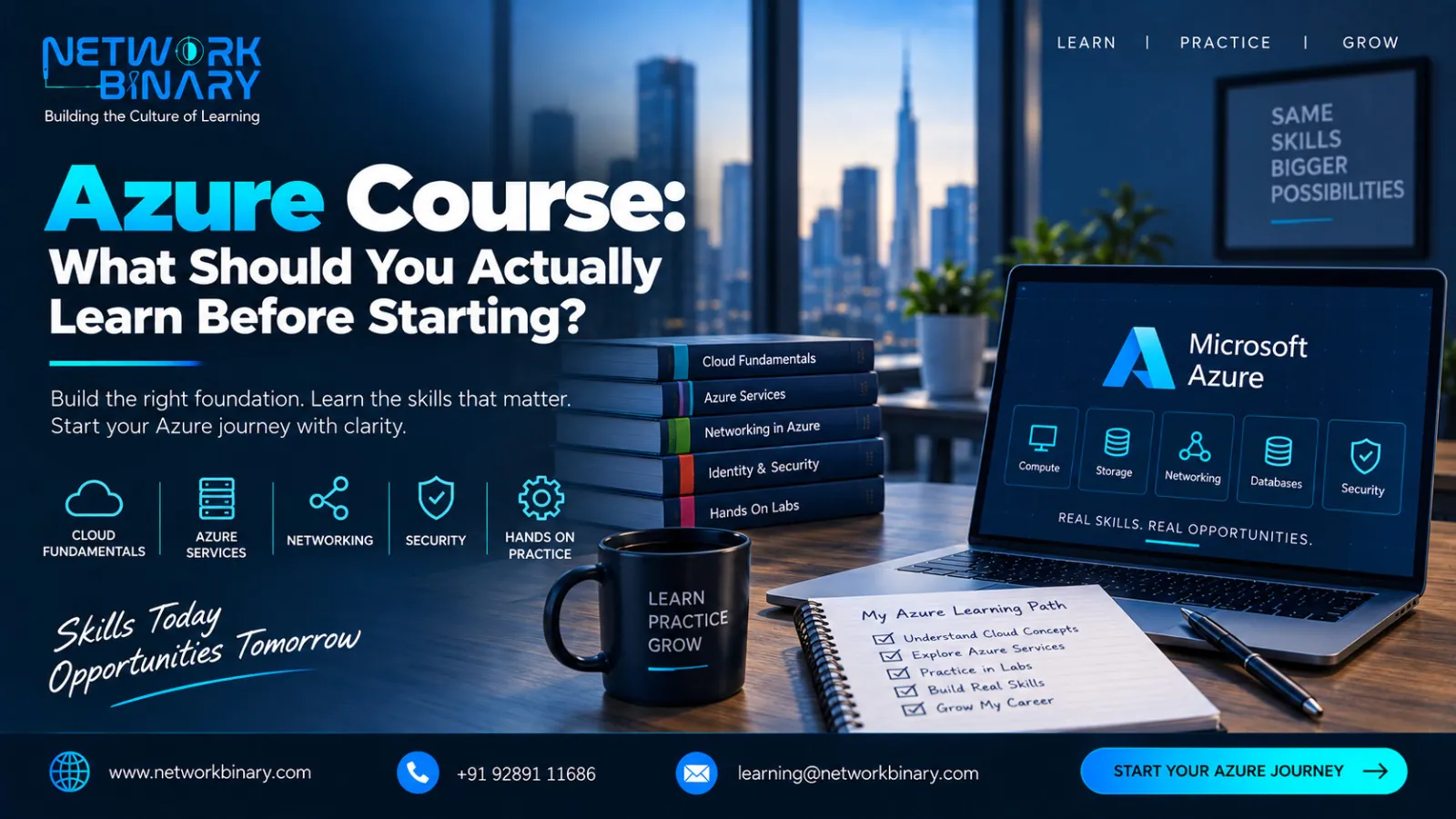
Starting an Azure Course can feel a little overwhelming. You search for Azure online and suddenly you are looking at dozens of services, certifications, learning paths, and technical terms you may have never heard before. At Network Binary, we often see beginners making the same mistake, trying to learn everything at once. You really do not need to. What matters in the beginning is understanding the fundamentals and knowing how the important pieces fit together.
First, Understand What Cloud Actually Means
Before jumping into Azure services, take some time to understand cloud computing itself.
What is a virtual machine? Why do companies move workloads to the cloud? What is the difference between running something on your own server and using a cloud platform? What do scalability and availability actually mean?
These may sound like basic questions, but they make a big difference later.
If you understand the ideas behind cloud computing, Azure services start making much more sense. Without that foundation, learning can quickly turn into memorising names and definitions.
Then Get Comfortable With the Main Azure Services
You do not need to know every Azure Service before you can say you understand Azure.
Start with the areas you are most likely to work with. Learn how computers, storage, databases, and networking work. More importantly, understand how they connect.
For example, knowing that Azure provides virtual machines is one thing. Understanding how you would connect that virtual machine to a network, give it access to storage and control who can access it is much more useful.
That is the kind of understanding that starts becoming relevant when you move from a classroom or lab into an actual IT environment.
Give Networking More Attention Than You Think
If you are new to cloud, networking might not be the first thing you think about.
It should be.
Virtual networks, subnets, IP addresses, routing, and security rules are all part of working with cloud infrastructure. Once you start building anything beyond an extremely basic environment, networking becomes difficult to ignore.
And if you already work in networking, you have a head start. Many of the concepts are familiar. The difference is that you are now applying them in a cloud environment.
Security Should Not Be an Afterthought
Another area beginners sometimes leave until the end is security.
That can be a problem.
You should start understanding identity, permissions, authentication, and access control early in your Azure learning. You also need to understand that giving someone access to a cloud resource is not just a technical task. It can have security and business consequences.
You do not need to become a cloud security expert on day one. But developing the right security mindset from the beginning will make you a much stronger cloud professional.
Do Things Yourself
This is probably the biggest difference between learning Azure and actually becoming comfortable with Azure.
Watching a trainer create a virtual machine is easy. Creating one yourself, configuring it incorrectly, wondering why it is not working and then figuring out what went wrong is where the real learning happens.
Spend time in a lab environment. Create resources. Configure them. Break things. Fix them.
You will remember those lessons far longer than something you simply memorised for an exam.
At Network Binary, we believe technology training should have this connection with practical work. The objective should not be to finish a course and forget most of it a few weeks later. It should be to build skills that you can actually use.
Your Existing Experience Can Help
You also do not have to become an entirely different kind of IT professional to learn Azure.
A system administrator already understands servers. A network engineer already understands connectivity. A cybersecurity professional already understands access and risk.
Azure gives you a way to extend those skills into the cloud.
That is why the best learning path will not necessarily be the same for everyone. Your background, current role and career goals should influence what you learn next.
So, What Makes a Good Azure Course?
Look for a course that gives you more than a list of Azure services.
You should come away understanding the basics of cloud computing, the Major Azure Services, networking, identity, and security. More importantly, you should get opportunities to practice what you learn.
Certification can come later. First, build an understanding of how things actually work.
A good Azure Course should leave you feeling that you can look at a cloud environment and understand what you are seeing, rather than simply recognising a few service names.
That is a much better place to start building a cloud career.