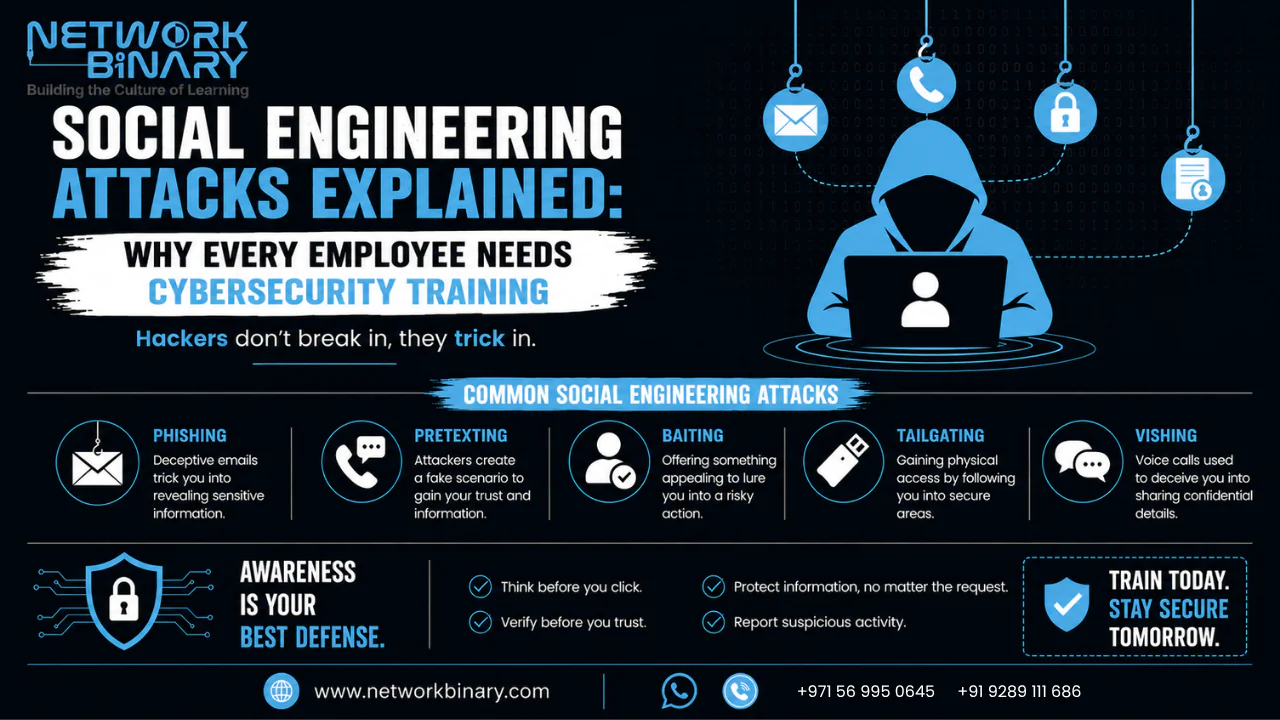
There was a time when cybersecurity operated quietly in the background managed by IT teams, rarely discussed beyond technical environments. That reality has changed. Today, cybersecurity awareness has become just as critical as the technologies themselves, because many security incidents do not begin with sophisticated system failures. They begin with something far simpler, a routine email, a quick decision, a moment of misplaced trust. That shift has redefined what cybersecurity actually means. It is no longer limited to systems and tools. It now depends heavily on how individuals respond in everyday digital situations.
The Gap Most Organizations Do Not Immediately See
Organizations continue to invest in security infrastructure and rightly so. Firewalls, monitoring systems, endpoint controls, and all of these are essential. But there is a quieter gap that often goes unnoticed. Most modern attacks are not trying to break systems. They are trying to bypass them entirely by targeting people.
And the issue is not carelessness.
More often, it comes down to the fact that people simply have not been exposed to situations where they can recognize risk as it unfolds. Cybersecurity awareness, when treated as a one-time exercise, does not solve this. It needs to be practical enough to stay with people when they are actually making decisions.
What Real Cyber Awareness Looks Like in Practice
Effective cybersecurity awareness is rarely about memorizing policies. It shows up in small moments.
When someone pauses before opening an unexpected attachment.
When a message feels slightly off and that instinct is taken seriously.
When there is enough clarity to choose caution, even under pressure.
These are not dramatic actions. But they are critical. And they do not happen by accident. They are built through exposure, repetition, and the right kind of learning environment.
How Network Binary Approaches Cyber Awareness and Workshops
At Network Binary, cybersecurity awareness is not delivered as a standard presentation or a checklist activity.
The focus is on making people see situations differently. Sessions are designed to reflect what actually happens in real working environments and not just what appears in theory. Participants are introduced to scenarios that feel familiar, sometimes even uncomfortable, because they mirror real risks.
Workshops are structured to engage without losing seriousness. There is discussion, interaction, and practical context, but always with a clear objective:
to ensure that awareness does not end when the session ends. Over time, this approach builds something more reliable than information; it builds judgment.
Why Organizations Choose Network Binary
When organizations invest in cyber awareness, they are not looking for content, they are looking for impact.
What often stands out in Network Binary’s approach is the balance between clarity and practicality.
- The learning is grounded in real situations, not abstract theory.
- The delivery is clear enough for non-technical audiences, without losing depth.
- The focus remains on how people will respond outside the session and not just during it.
There is also a deliberate effort to avoid overloading participants. The goal is not to cover everything, but to ensure that what is covered is understood, retained, and applied. That difference, while subtle, is what makes awareness effective.
From Awareness to Behaviour
The outcome of good cybersecurity awareness is rarely immediate. It shows up gradually. Someone hesitates before clicking. A concern is raised earlier than usual. A team becomes slightly more cautious and that caution proves valuable. Individually, these may seem like small shifts. But collectively, they reduce risk in a meaningful way. And over time, they shape how an organization approaches security, not as a rule, but as a habit.
A More Practical Perspective on Security
No organization can eliminate risk completely. But it can significantly reduce exposure by ensuring that its people are better prepared. Technology will continue to evolve. Threats will continue to adapt. What remains constant is human judgment. And when that judgment is supported by the right awareness, training, and reinforcement, it becomes one of the most dependable layers of security.
Closing Note
Cybersecurity awareness is not about adding more information. It is about making that information usable at the right moment. When individuals understand what to look for, and more importantly, how to respond, security becomes part of everyday thinking. And that is where it begins to work.
With the right structure, guidance, and real-world perspective provided by Network Binary, awareness moves beyond theory and becomes something far more practical, something that supports better decisions, reduces risk, and strengthens how organizations operate in an increasingly complex digital environment.